


Homegrown settlements generate self-built housing for 24% of the world’s urban population. We know these neighborhoods have numerous challenges—many of which are what propel their residents to create their own housing solutions in the first place. But the efforts of international institutions, governments and society to “solve” the issue and the stigma with which these communities are seen have not addressed these challenges. They often exacerbate them. And informal settlements continue expanding: meeting more peoples’ need for housing.
From May 18-22, 2026, the Favela Hub will perform a unique role at the 2026 World Urban Forum’s Urban Expo, offering a convening space for people from informal settlements and allies who work closely with these settlements to focus on issues and topics from the perspectives of residents themselves.
We are at a pivotal point in the evolution of human habitats. The legitimization and governmental support of homegrown settlements are key to their upgrading. This would trigger big changes in these communities, which evolve quickly even without the desirable support. We hope our exhibit at WUF13 will contribute to the efforts of many local communities that struggle to claim citizenship and space in their cities.
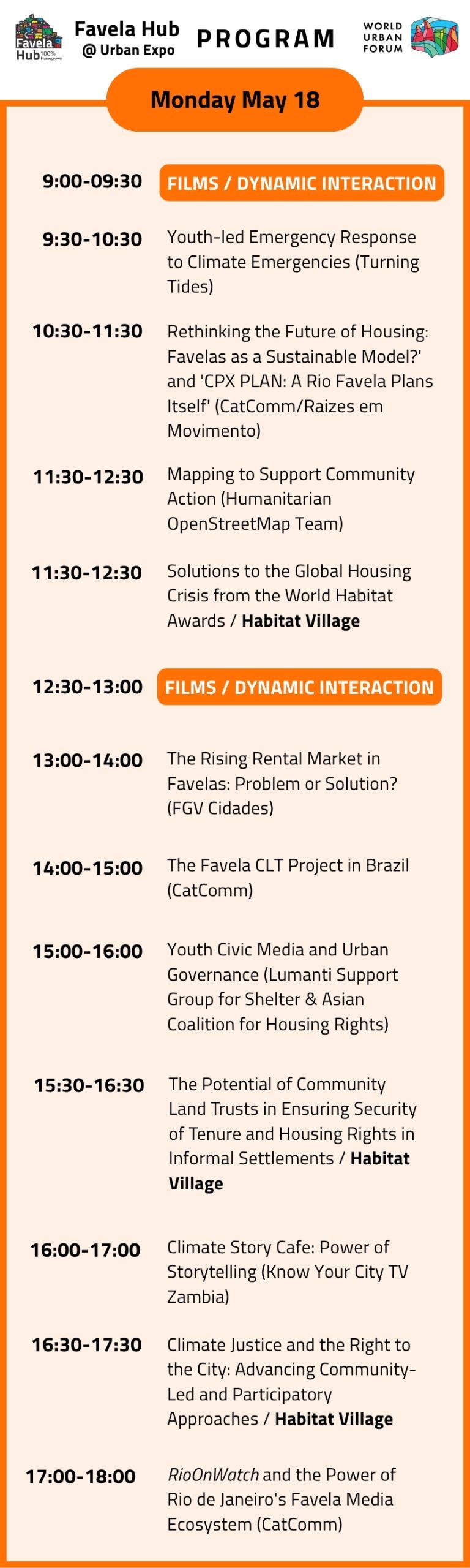
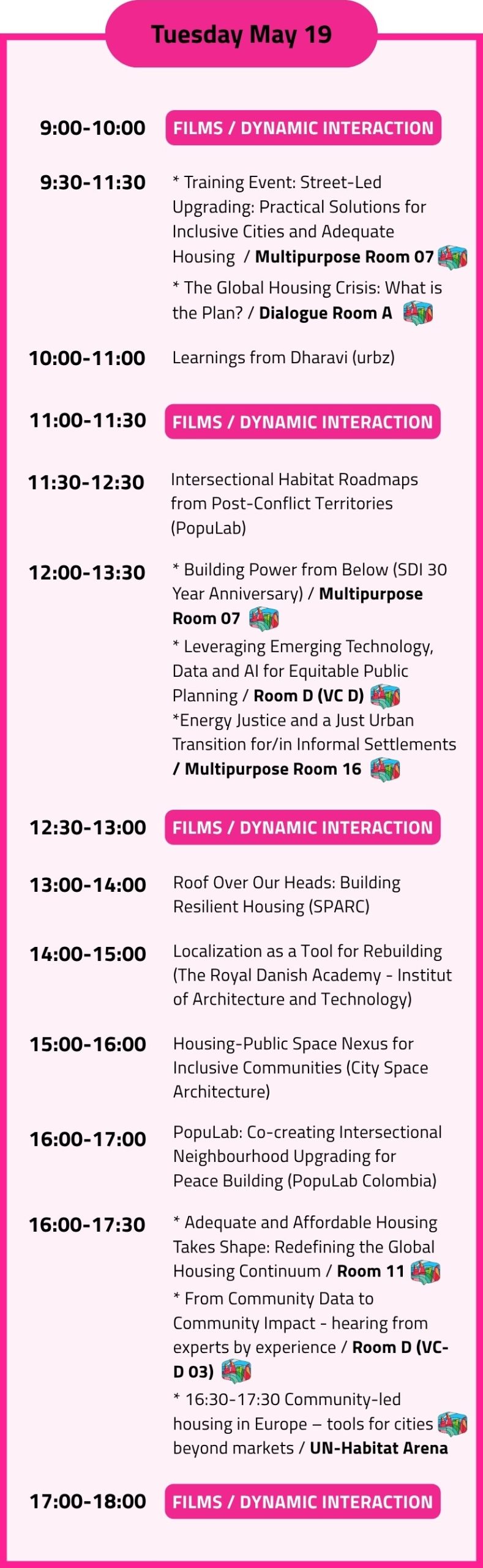
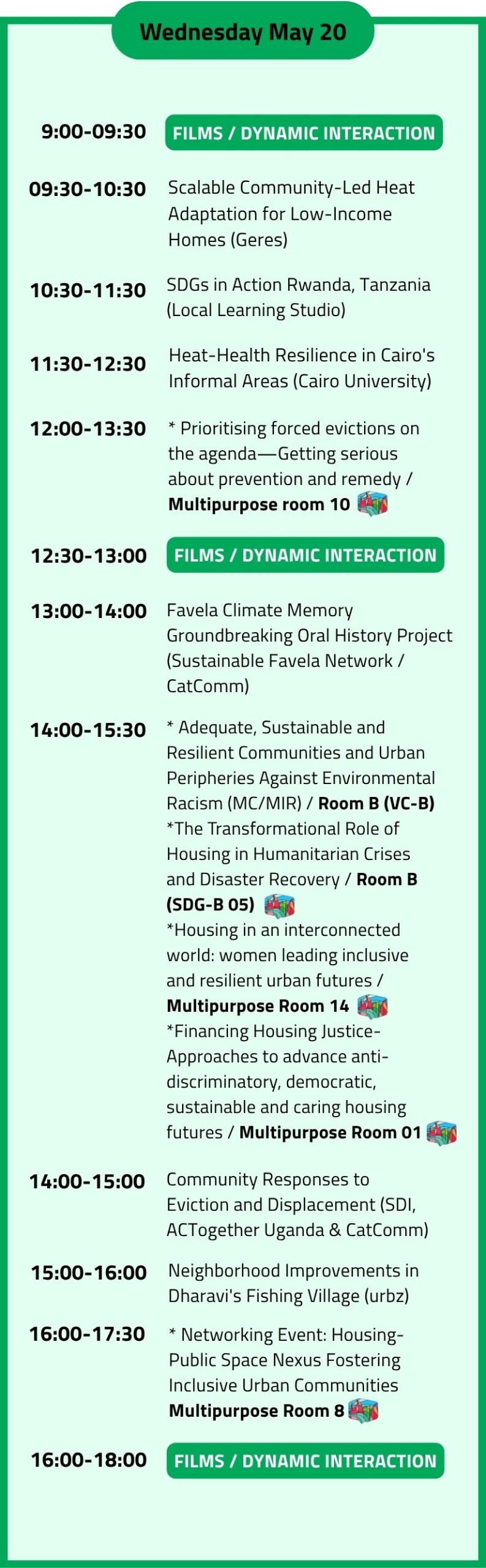
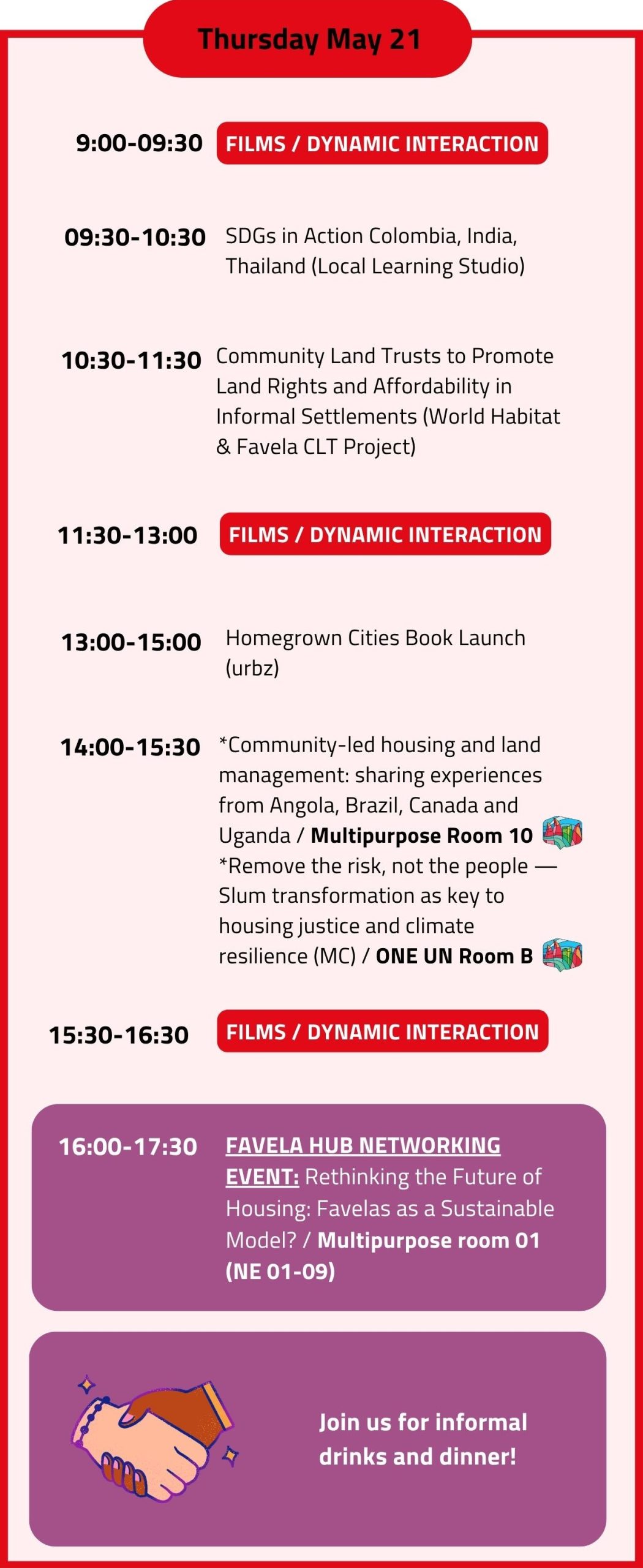
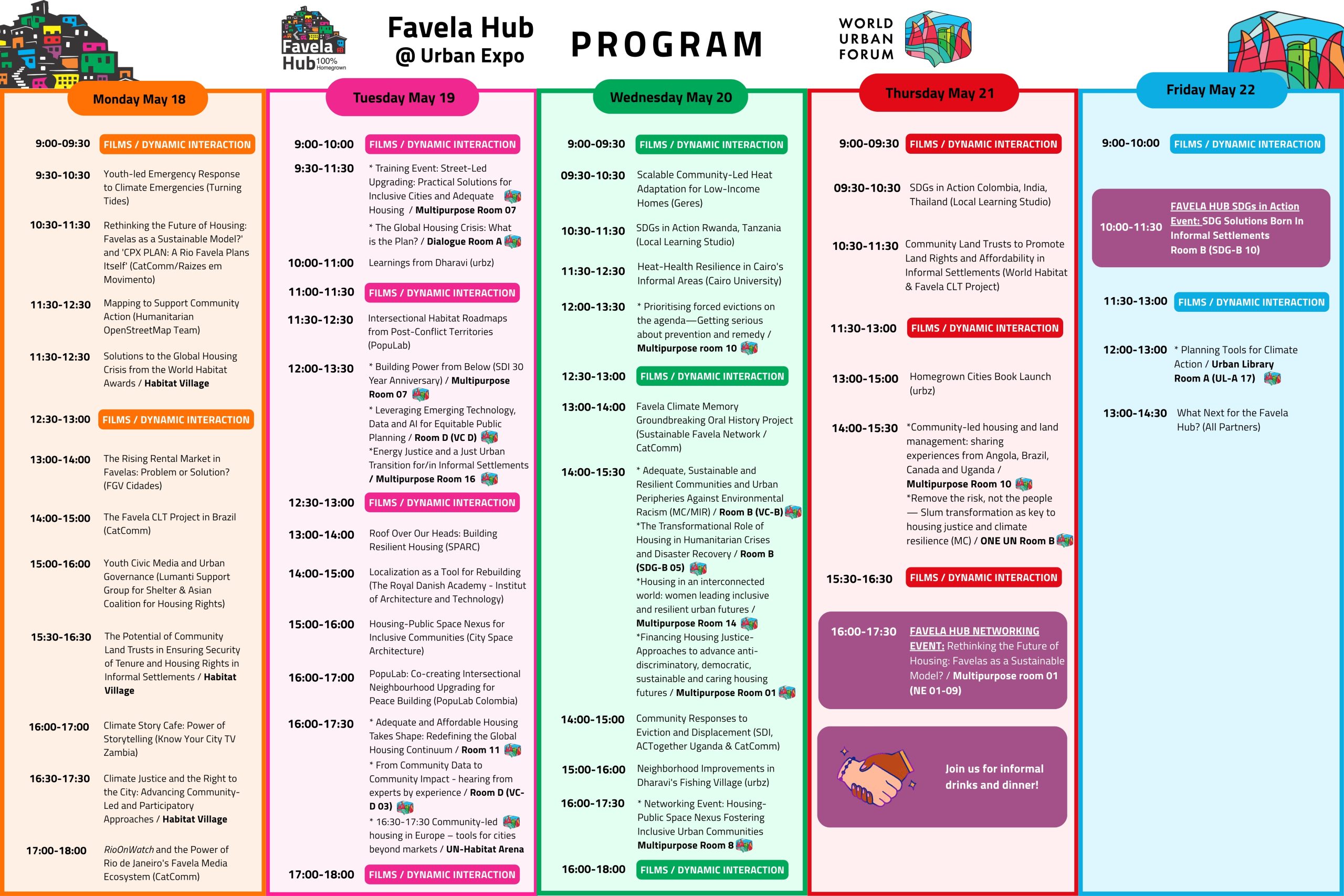
FULL PROGRAM as of May 17 (horizontal)
Scroll down for vertical version more suitable to mobile phones.
Organizing Partners: Catalytic Communities, Rio de Janeiro, Brazil and urbz, Mumbai, India
Participating Partners:
- Asian Coalition for Housing Rights, Lalitpur Metropolitan City, Nepal
- Center for Sustainable Development (CSUD), Colombia Climate School, New York, USA
- City Space Architecture, Bologna, Italy
- Community Design Agency, Mumbai, India
- Consortium for Sustainable Urbanization, New York, USA
- The Danish Academy Institute of Architecture, Copenhagen, Denmark
- DataLabe, Rio de Janeiro, Brazil
- Geres, Aubagne, France
- Favela CLT Project
- FGV Cidades, Brazil
- Habitat for Humanity, USA
- Habitat International Coalition
- Humanitarian Open Street Map
- Instituto Decodifica, Rio de Janeiro, Brazil
- Kounkuey Design Initiative (KDI), Nairobi, Kenya
- Local Learning Studio, New York, USA
- Populab, Cali, Colombia
- Raizes em Movimento, Rio de Janeiro, Brazil
- RioOnWatch, Rio de Janeiro, Brazil
- SDI, Cape Town, South Africa
- Social Capital Initiatives (SCI)
- SPARC – Society for the Promotion of Area Resource Centers, Mumbai, India
- Sustainable Favela Network, Rio de Janeiro, Brazil
- Sustainable Urbanism, Department of Architectural Engineering at Cairo University, Cairo, Egypt
- TETO Brasil, São Paulo, Brazil
- Turning Tides, Worthing, UK
- UrbaMonde, Geneva, Switzerland
- Urban Poor Consortium, Jakarta, Indonesia
- World Habitat, Leicester, UK
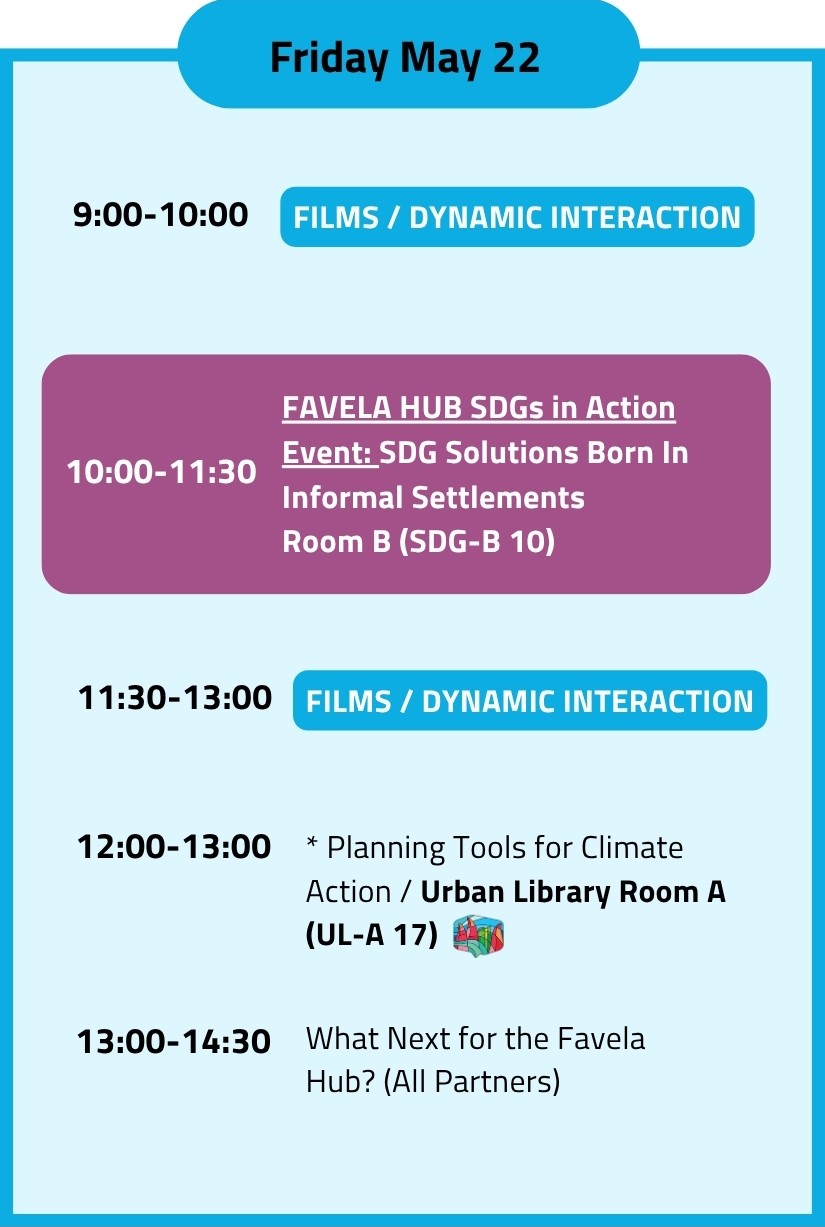
FULL PROGRAM (vertical for mobile phone):